Designing Actionable Player Sentiment Insights on Lumos
I joined Lumos just before its launch, where I owned the sentiment analysis feature end-to-end & shipped it within a month. It was an innovative start-up environment whose success dependent on a few members who went above & beyond.
Details hidden to protect confidentiality
Product Design
Customer facing
The Product
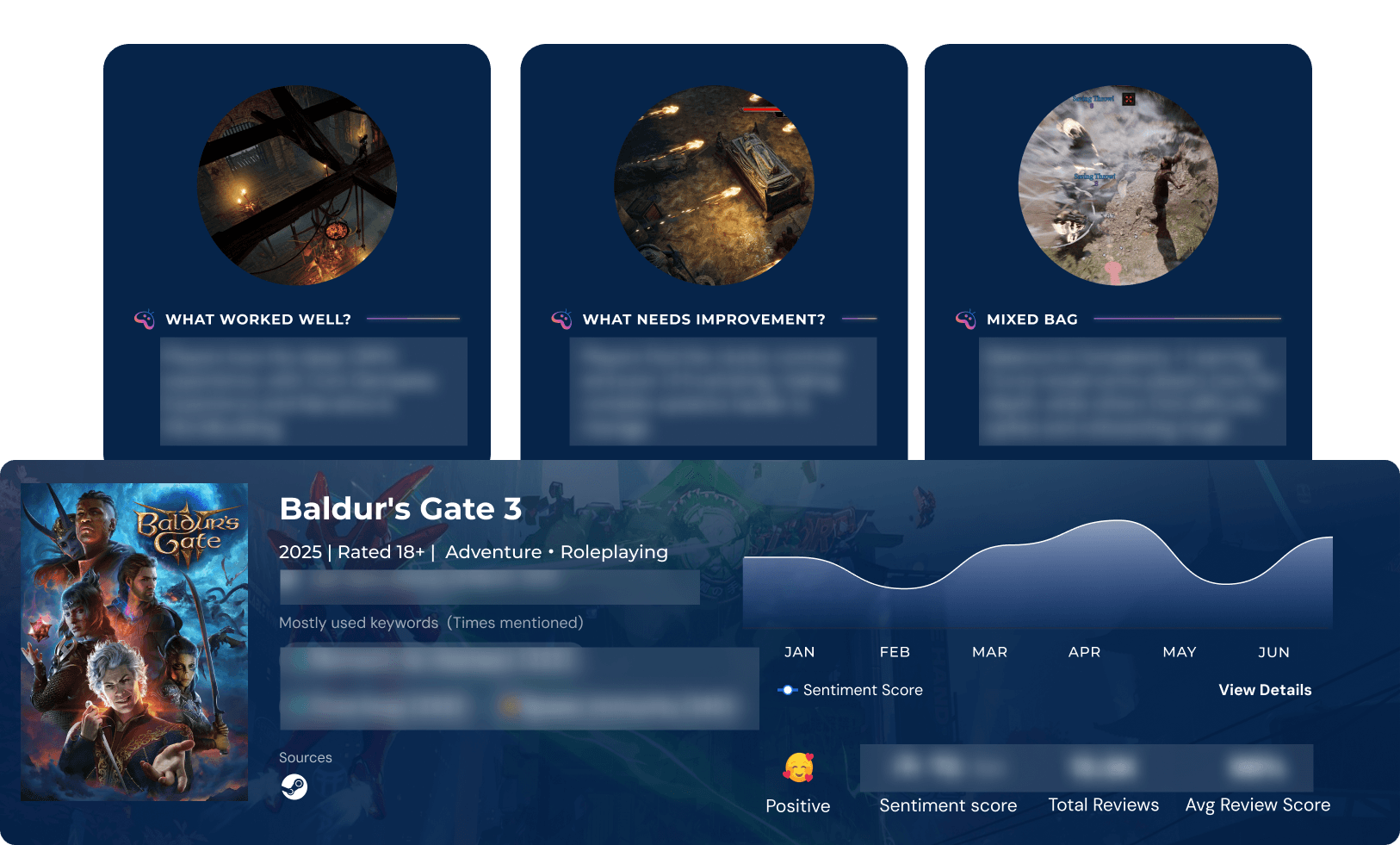
Lumos is Gameopedia's AI-driven platform built for game studios and investors. Today, studio owners and investors rely on manually scanning platforms like Reddit and Steam to gauge player response to a game. The Sentiment analysis is a high-level read on how players feel about a game, and a granular breakdown of why, backed by real reviews and verified by the subject matter experts.
The Impact
Sentiment analysis is one of its most validated, frequently requested capabilities. It's now one of the most-used features on the platform, with 87% user engagement (till march'26)
Timeline
Jan 2026 - March 2026
Role
UX Design
Rapid Protoyping
Visual Design
Data driven decision making
Team
1 Product manager
1 Designer
5 Engineers
Challenges
We noticed low discoverability in the first two weeks post-launch with no dedicated dashboard and no direct placement on the left nav, the feature struggled to surface naturally within the existing user flow.
The fix was subtle, not structural. I used the onboarding inputs to personalize visibility, users who selected "game research" as their interest saw Sentiment Analysis surfaced in their dashboard's top section. On the game breakdown page itself, a real player comment was placed as an eye-catching visual element, quietly routing users into the feature.
Key Learnings
01
I learned to ship fast with several business-driven, hypothesis-led decisions without losing craft
I had to move with partial information and validate as I went. Using vibe coding tools like Figma Make, Claude, and Lovable let me test direction with stakeholders fast — before investing in full-fidelity design. There wasn't time for the deep user studies I'd normally lean on. I had to trust signals like stakeholder input, competitive context and the team's judgment to move fast then let real usage data confirm or correct the direction after launch.
02
I learned that a great feature still fails if no one finds it.
Sentiment analysis was one of Lumos's strongest USPs, but the first two weeks proved that good design isn't enough on its own visibility has to be designed for just as deliberately as the feature itself. Small, subtle placement decisions moved engagement more than any feature improvement could have.
03
I learned how much information architecture matters when designing for multiple personas.
Lumos serves users with different depths of need — some just want the headline, others want to dig into evidence and nuance. Structuring the page as summary-first, detail-on-demand meant every persona could get what they needed without the page dictating one single way to read it.
The Impact
The engagement on the page is 87% within a week after the launch, and it held above 85% for the following month. Sentiment anlaysis remains one of the top 3 features on Lumos since the launch in march'26.