Best Thesis Award'24
Designing for Independence: Assistive Currency Transactions for Individuals with ASD & ID
For my Master's thesis at IIT Guwahati, I designed an assistive device for individuals with ASD (Autism Spectrum Disorder) and ID (Intellectual Disability) that enabled real, independent currency transactions tested with real users, loved by the school, and awarded Best Thesis 2024.
Under the guidance of Dr. Pankaj Upadhyay
Product Design
Inclusivity

The Problem
Imagine your card declines and UPI fails. You open your wallet ₹100, ₹50, ₹20, ₹10 notes and the task of making exactly ₹67 begins. You count, recount, try a few combinations and eventually hand over a bigger note. "Keep the change." Not generosity just the math feeling like too much.
Now imagine this is every transaction, every day.
For individuals with Autism Spectrum Disorder (ASD) or an Intellectual Disability (ID), mental math during real-time transactions isn't an occasional inconvenience it's a recurring barrier that quietly erodes confidence, discourages independence, and leaves caregivers hesitant to step back and let them try.
*As its a spectrum, it may vary amongst the individual.
Getting into their shoes
To understand this problem from the inside, research sessions were conducted at a local school for specially-abled individuals, with participants ranging from 18 to 45 years old, all with the school's consent.
Across participants, what stood out most: these were capable, independent-minded individuals held back by one specific, solvable barrier.
You must be wondering, why a physical device
Individuals on the higher-functioning end of the spectrum often manage daily activities independently and many with ASD are naturally methodical and systematic a trait worth designing with, not around.
Handling physical money builds a stronger, more intuitive sense of responsibility than tapping a screen.
For users with sensory considerations, a digital interface wasn't the natural first choice.
It teaches the fundamentals of a transaction, not just the outcome of one.
It doubles as a teaching aid for schools and training environments.
A digital product would have meant a steeper learning curve for this group, right out of the gate.
A digital version remains a natural next step but only once trust and confidence are built first, not before.
Artha in action

Enter the amount, ₹57, and press OK.
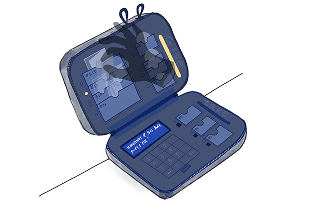
A light turns on next to the ₹50 pocket that's the note to hand over.
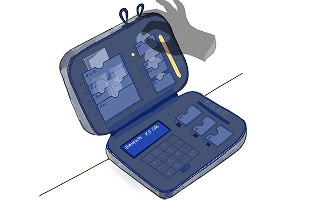
Press OK. A light turns on next to the ₹5 pocket, hand it over.

Press OK. A light turns on next to the ₹2 pocket, hand it over.

Press OK. Artha confirms: "Transaction completed. Fill the pockets before your next transaction."
On-screen prompts and audio cues in the user's own mother tongue, alongside the LED guidance so the path from amount to action is never ambiguous.
It ships with an illustrated quick-guide for both users and supervisors, and is built into a portable case for everyday use.
Artha went through two rounds of real-world testing
Round 1 Functional prototype.
Testing was successful users completed transactions within 2–4 attempts, with the light-based guidance proving to be the most intuitive element for most participants.
Round 2 Final prototype
The final prototype was tested back at the school a complete success. Users found it genuinely intuitive, with two clear next steps surfaced: minor refinements to the visual cues and a structured training plan for new users.
Key Learnings
01
I learned to design with users' strengths, not just around their limitations.
The research kept surfacing what participants could do recognize coins, read numbers, associate physical actions with objects. Designing with those strengths, rather than compensating for weaknesses, is what made Artha feel empowering rather than remedial.
02
I learned that quick prototyping and testing is the fastest way to validate what research can't answer alone.
Several design decisions the pocket arrangement, the button placement, how users actually interacted with notes and coins couldn't be resolved on paper. Building a functional prototype and putting it in front of real users early surfaced insights that no amount of desk research would have caught.
03
I learned that empathy, applied with the right depth and within the right timeframe, is what drives successful outcomes.
It's easy to over-research or under-research a sensitive user group. The right balance going deep enough to design with genuine understanding, but moving fast enough to stay within a thesis timeline is what kept Artha grounded in real needs without losing momentum. Empathy wasn't a phase; it was a throughline.
Impact
Participants completed real transactions independently within 2–4 attempts, with supervisors observing rather than stepping in the quiet shift from dependence to independence that the entire project was designed to create. Both participants and supervisors responded positively and the school head requested a polished, production-ready version of the device.
At IIT Guwahati, the thesis jury was impressed with a specific callout for the device's portability and clean execution earning Artha the Best Thesis Award 2024.
Beyond the thesis, Artha was presented at exhibitions focused on inclusive design, social impact, and designing for diversity, extending its reach well past the academic context it was born in.